Reducing Scope 2 and 3 Emissions: Why Your Heat Transfer Fluid Choice Matters in Indirect Refrigeration Systems
Climalife UK
The overlooked role of HTFs in indirect refrigeration
 For many industrial refrigeration systems, using B2L, A3 or low GWP refrigerants (A1 or A2L), a chiller with a secondary cooling circuit is often necessary. These indirect refrigeration systems rely on heat transfer fluids (HTFs) to carry thermal energy between the refrigerant and the application. Yet, while refrigerant choice is carefully considered, the HTF is often overlooked, despite its significant impact on sustainability, efficiency, and compliance.
In large systems, thousands of litres of HTF circulate, making it a major contributor to the overall environmental footprint. Traditional HTFs, such as mono-propylene glycol (MPG) and mono-ethylene glycol (MEG), are derived from petrochemicals and produced through energy-intensive processes. This misalignment with sustainability goals presents a challenge for organisations aiming to reduce Scope 2 and 3 emissions.
The limitations of traditional HTFs
MPG and MEG are the most common HTFs used in indirect systems. MPG is often selected for food-related applications due to its non-toxicity, while MEG is preferred in low-temperature systems because of its lower viscosity and reduced pumping power requirements. However, both are derived from crude oil, and their production processes generate significant emissions. This undermines efforts to create truly sustainable systems, particularly as corporate and regulatory pressures to cut emissions intensify.
MPG and MEG are the most commonly used products on the market however; there is an alternative that can significantly help to reduce Scope 2 and/or Scope 3 emissions through its lower viscosity and bio-sourcing.
Bio-PDO HTFs: a sustainable alternative for indirect systems
Bio-PDO based HTFs, such as Climalife's Greenway® Neo N, offer a sustainable solution. Sourced from renewable field corn, these fluids provide a range of benefits:
- Reducing scope 3 emissions: production of bio-PDO emits 84% less CO₂ equivalent and consumes 70% less non-renewable energy compared to traditional MPG (source: SimaPro, eco-invent).
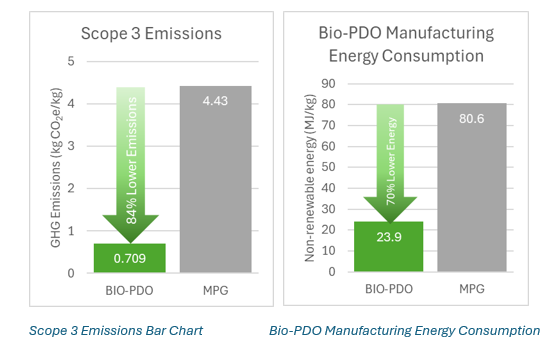
The manufacturing process for bio-PDO consumes significantly less non-renewable energy.
- To illustrate the impact in Tons of greenhouse gases emissions, for a production of a 24T bulk tank of glycol, selecting Greenway® Neo N would represent a reduction of 26.8T of GHG emissions compared to an MPG based HTF.

Having established the significantly lower environmental impact of bio-PDO during its production, it also stands out for its ability to enhance operational efficiency, particularly in reducing energy consumption.
- Reducing Scope 2 emissions with operational efficiency:
HTFs have a limited effect on Scope 1 emissions but they can have an important impact on the Scope 2 emissions from the pumps required in the secondary refrigeration circuit. The pump power will depend on the HTF flow rate, which will be similar for all glycol based HTFs, as well as the viscosity of the HTF at the operating temperature which will be directly proportional to the power consumption of the pump i.e. lower viscosity will result in lower pump energy consumption.
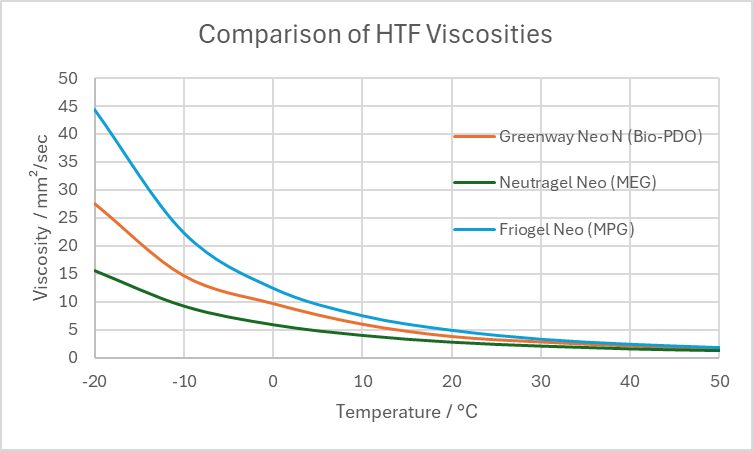
The viscosity characteristics of bio-PDO, when compared to MPG, can deliver significant operational advantages. By opting for bio-PDO, it is possible to reduce both pipe and pump dimensions during the design phase, which directly translates into lower energy consumption. Switching from MPG to bio-PDO can offer additional benefits, even in existing systems. However, it is essential to conduct a pressure drop calculation and a feasibility study to ensure a smooth and effective transition.
Corrosion inhibitors: ensuring longevity without compromise
Regardless of the glycol chosen, corrosion inhibitors are essential to preserve system longevity and efficiency. There are different types of corrosion inhibitors; some coat all the surfaces, which can become a barrier to the heat transfer. The most advanced technologies, such as those developed by the Climalife R&D team and used exclusively within their products, can protect circuits without compromising heat transfer, ensuring optimal long-term performance.
Food safety considerations in indirect systems
While MPG is often referred to as "food safe," no HTF is considered safe for direct contact with food. However, some HTFs, such as the Greenway® Neo N range from Climalife, have earned the NSF HT1 registration, certifying their suitability for use in secondary refrigeration systems where accidental food contact may occur. This provides an additional layer of assurance for operators in the food and beverage industry.
Other applications of Bio-PDO HTFs
Beyond indirect refrigeration, bio-PDO HTFs are ideal for heat pumps and solar thermal systems, due to their thermal stability (up to 200°C) and efficiency, geothermal systems, thanks to their biodegradability and bacteriostatic properties, resistance to biological growth plus domestic and industrial heating, where they ensure consistent performance and protection.
The role of refrigerants in indirect refrigeration
The phasedown of high-GWP refrigerants in Great Britain means indirect refrigeration systems are increasingly necessary for safe, low-GWP operation. Many industrial systems using A3, B2L or low GWP refrigerants (A1 or A2L) rely on secondary HTF circuits.
When aiming to reduce emissions, it is essential not to overlook the importance of using refrigerants with a very low GWP (Scope1). For Scope 2 emissions, adopting an eco-efficiency approach is key to compare the different refrigerants that we can use for the chillers. For example, with new R-1234ze chillers (oil-free compressors), we can optimise the coefficient of performance (COP), reduce electricity consumption and result in lower emissions compared to ammonia screw chillers. Energy consumption is having more of an impact today, making it crucial to consider both the refrigerant and the HTF for a truly sustainable system.
However, sustainability should not end with refrigerant choice. The HTF plays a critical role in reducing Scope 2 and 3 emissions, making it just as important as the refrigerant in achieving true sustainability.
Conclusion: rethinking HTFs for sustainable indirect systems
In indirect refrigeration systems, the HTF is just as critical as the refrigerant. As environmental scrutiny intensifies, operators must evaluate their HTF choices to ensure they are not overlooking a key opportunity to reduce emissions and improve efficiency.
Is your heat transfer fluid helping you achieve your environmental targets, or is it an overlooked opportunity? For forward-thinking organisations, bio-based HTFs like Greenway® Neo N from Climalife offer a smart, sustainable solution for indirect refrigeration systems.